Audit Design & Scope
The objective determines the method. The question an audit is intended to answer should be established before samples, categories, or dates are selected, as each subsequent design decision — and much of the field cost — follows from that choice.
Establishing the objective
Each audit objective imposes distinct sampling requirements. A study designed to characterize composition, for example, cannot generally support capture-rate estimates unless linkage between streams was incorporated into the sampling design. The table below relates five common objectives to the sampling requirements each implies.
| Objective | What you must sample | Design implications |
|---|---|---|
| Composition what's in the stream |
The stream itself (usually garbage) | Category list to tier 2–3; enough sorting samples for the precision you'll claim |
| Generation rate kg per unit per time |
All streams from a known generator count over a known period | Complete capture of the generation period; verified counts (employees, households, beds, covers) |
| Capture rate divertible material actually diverted |
Garbage and each diversion stream from the same generators | Requires stream linkage: samples must originate from the same households or departments over the same period |
| Contamination rate non-target material in a diversion stream |
The diversion stream (recycling or organics) | Category list built around the program's accepted-materials list, not a generic one |
| Program evaluation did the intervention work |
Whatever the baseline sampled — exactly | Method, categories, season and strata held constant; the comparison itself is the principal output |
Choosing the audit type
Defining the sampling frame
The sampling frame defines the population to which results can properly be applied: which generators, which streams, and which period. Estimates extended beyond the frame are extrapolations and should be identified as such in the analysis (§09).
Generation period
Sample a complete, representative generation period — 24 hours at minimum, or a full collection cycle (often one week) where storage allows. Coordination with custodial staff helps ensure that no material is removed early or held back; an unrepresentative sampling period that goes unrecognized is among the most common limitations of facility audits. Occupancy for the period (employees on site, patients, students, covers served) should be recorded, as it serves as the denominator for all generation rates.
Whole-building vs. departmental
If the intended intervention is building-wide, the consolidated stream is the appropriate sample. If it is local — a kitchen, a loading dock, a laboratory — departments should be kept in separate labelled bags from the point of generation onward, since streams cannot be disaggregated once consolidated.
Multi-tenant buildings & shared compactors
Shared compactors prevent attribution of material to individual tenants. Options, in order of preference: intercept material before it reaches the shared container (floor-by-floor collection for the sample period); arrange a compactor pull dedicated to the tenant's period; or report at the building level with the limitation noted. Results from shared containers should not be attributed to individual tenants.
Timing within the year
Select a representative operating week, avoiding atypical periods such as year-end shutdowns, inventory clearances, or examination periods. Where operations are strongly seasonal (retail, campuses, tourism), one audit per distinct operating mode is generally more informative than repeated audits within a single mode.
Sampling unit & selection
The unit is the household set-out (or the collection-route segment). Draw households randomly within strata; in practice many municipal studies select consecutive homes on randomly chosen streets to keep collection logistics feasible — St. Albert's 2022 study, for example, sampled 100 households as 10 homes/day over 10 collection days, per season. Any such compromise should be documented in the methodology section of the report.
Stratification
Stratify by what actually drives variation: housing type first (single-family vs. multi-family are different populations, not strata of one), then collection service level, then neighbourhood characteristics where the sample budget allows. Plan roughly 100 households per stratum as a working baseline, more if you intend stratum-level claims.
Set-out vs. generation
A curbside sample measures what was set out, not what was generated — backyard composting, in-sink disposal, and stockpiling all sit outside the frame. Counting set-outs on route adds participation and set-out rates to the composition data at minimal additional cost.
Privacy & ethics
Collect by anonymized sample ID, never retain addresses with results, photograph nothing that identifies a household (mail, prescriptions, documents — these are bagged unread into the paper category). Privacy and legal review should be completed during study design.
Seasonality
Composition is seasonal — yard waste can swing from near-zero in February to the dominant component in May, and food waste, packaging and C&D all move with holidays, weather and operating cycles. A single-season study provides a point-in-time estimate and should be identified as such; the accepted standard for community-wide estimates is two to four events across the year, weighted together in analysis (§09). Sampling periods should avoid statutory holidays, major community events, extreme weather, and atypical operations.
Streams and category depth
Sample every stream your objective touches — capture rates need garbage plus the diversion streams; contamination requires the diversion stream sorted against the program's own accepted-materials list. Category depth carries a direct cost implication: each additional tier substantially increases sorting time for the affected material. The three-tier list in §06 is designed to be trimmed: sorting to tier 2 is the default, with tier 3 opened only where the objective requires it (for example, avoidable versus unavoidable food waste in a prevention study, or resin-level plastics where required by a processor).
Documenting the design
The decisions described on this page are recorded in a one-page design brief — a single reference that aligns the field crew, the commissioning organization, and the final report. The same document serves as the protocol for subsequent audits, since the validity of before-and-after comparisons (§11) depends on holding the design constant.
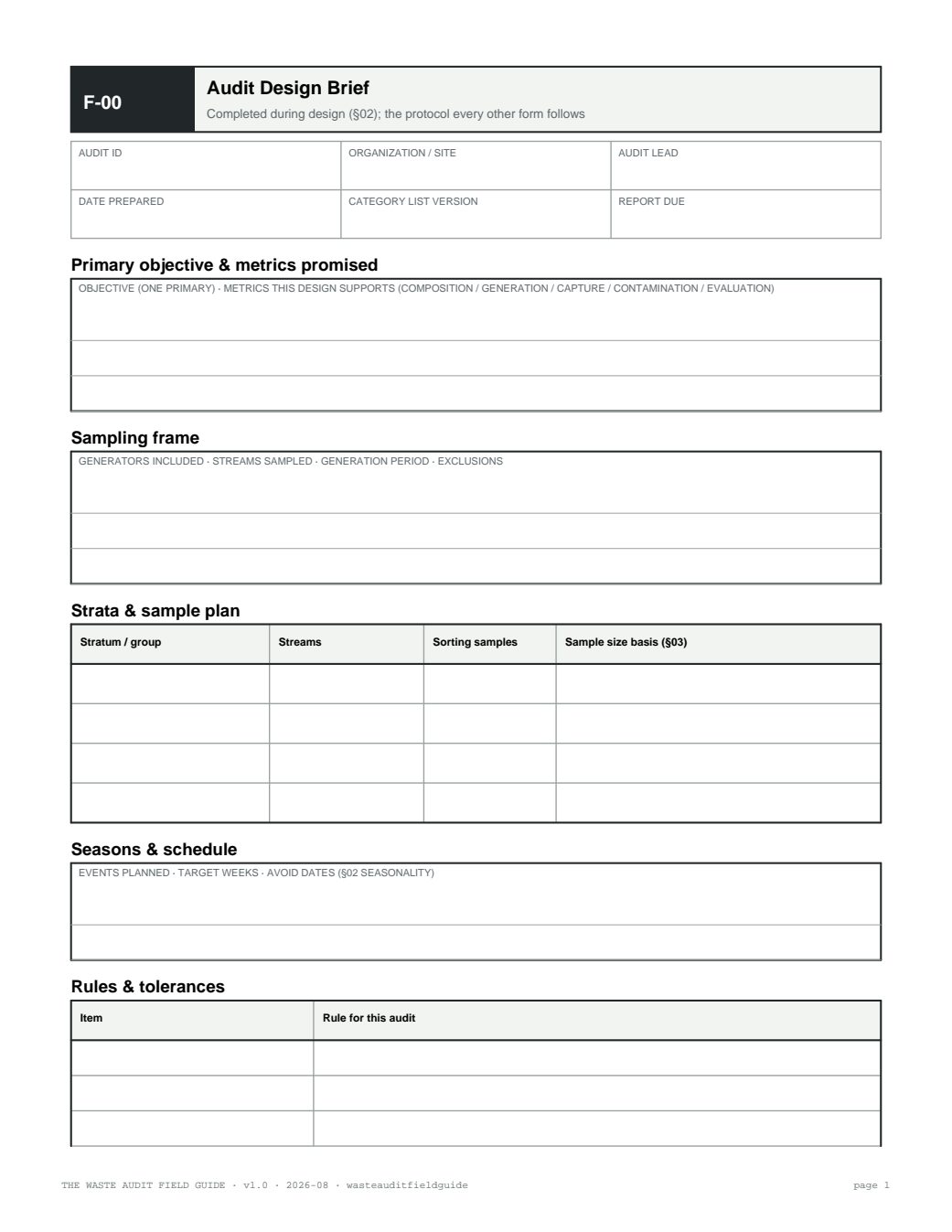
F-00 · Audit Design Brief
Objective · frame (generators, streams, period) · strata & sample counts · season plan · category list version · sub-sampling rule · QA tolerances · known limitations.
PDF — click the sheet or the buttonDesign review checklist
Ten questions reviewed before fieldwork is scheduled: whether sample linkage supports the intended metrics; whether the period is representative; whether strata correspond to distinct populations; whether scale resolution is adequate for the smallest categories; whether an inclement-weather plan is in place. Full checklist ships with the form.
Two further design questions — how many samples the audit requires, and how large loads are reduced to sortable size — are addressed in §03 Sampling & Sample Size, together with guidance for audits conducted under resource constraints.
Sources & further reading
- City of St. Albert — Residential Waste Composition Study, 2022 (worked example of a two-season, 100-household municipal design and its documented compromises)
- Stewardship Ontario — Curbside Material Composition Study (multi-season, multi-municipality curbside methodology)