Conducting the Sort
Sort day is where the design (§02), the sampling plan (§03), the safety program (§04), the site (§05), and the category list (§06) converge. This section describes the day itself: the crew, the sequence each sample moves through, the protocols that keep samples separate and data defensible, and what to do when the day departs from the plan.
The day at a glance
Crew and supervision
A sort crew has three defined roles. The minimum viable crew is three (supervisor, one sorter, one weigher-recorder, with the supervisor assisting at the table); the standard configuration is four to five; beyond about six sorters, a second table and a second recorder serve better than a longer table. Supervision does not scale past roughly six sorters per supervisor — rulings queue, and consistency degrades.
Sort supervisor · 1
Owns safety, category rulings, pace, and QA. Delivers the briefing, manages set-asides, rules on edge cases and records each ruling on F-04. Does not sort except in a three-person crew — the supervisor's job is to watch everything.
Sorters · 2–6
Open bags, spread material, sort to category bins, flag anything unusual. Rotate stations at every break — table position, tipping, and (with training) the weigh station — for ergonomic relief and consistency.
Weigher / recorder · 1
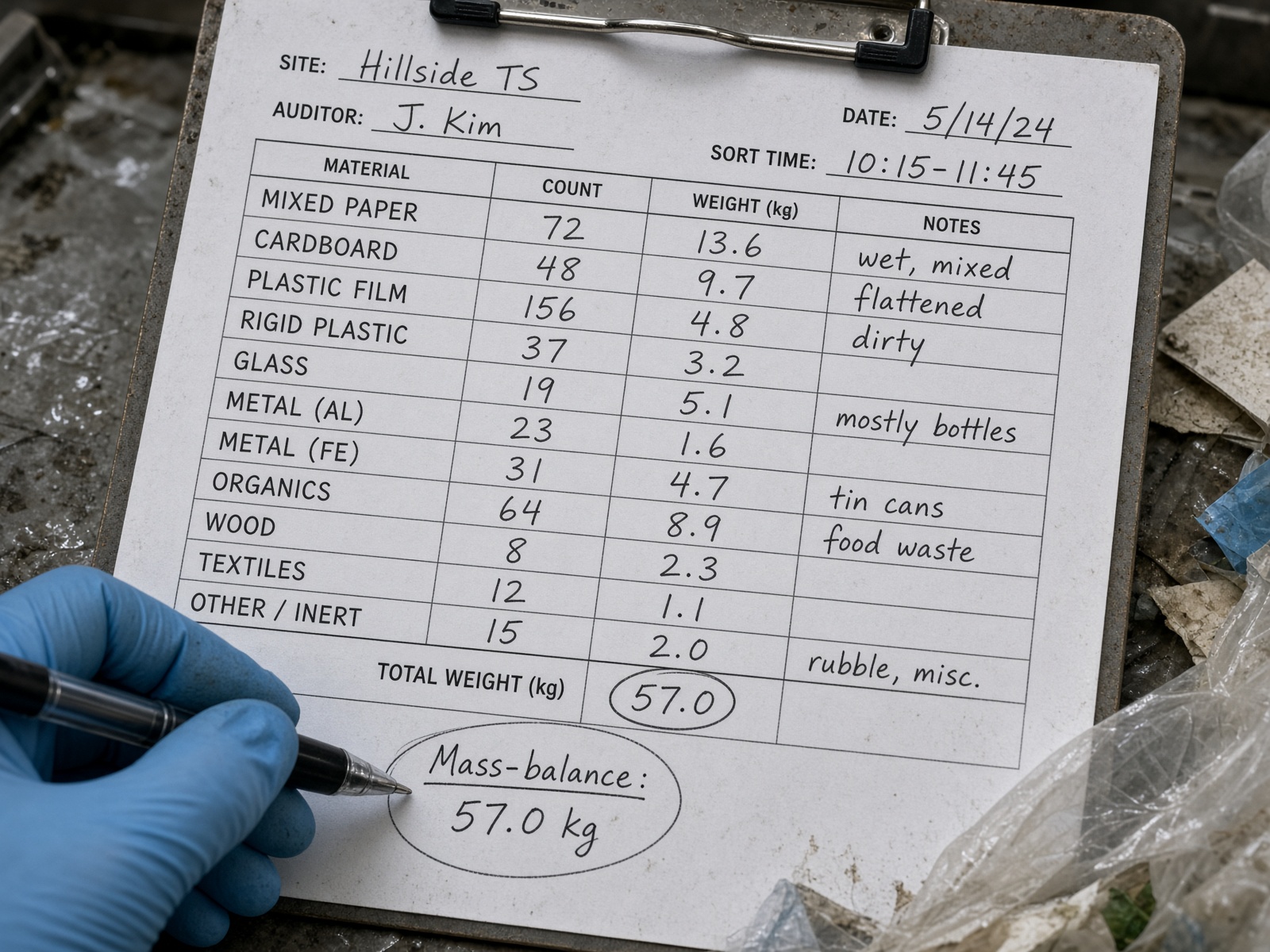
Runs the scale and the forms: tares, gross weights, category nets, scale verifications, and the mass-balance check that closes every sample. Keeps the tally sheet legible — this person's handwriting becomes the dataset.
The sequence, sample by sample
Every sample moves through the same seven steps. The steps are not optional and their order is not negotiable; the QA check at the end is what converts a pile of weights into a defensible record.
Receive & verify the sample
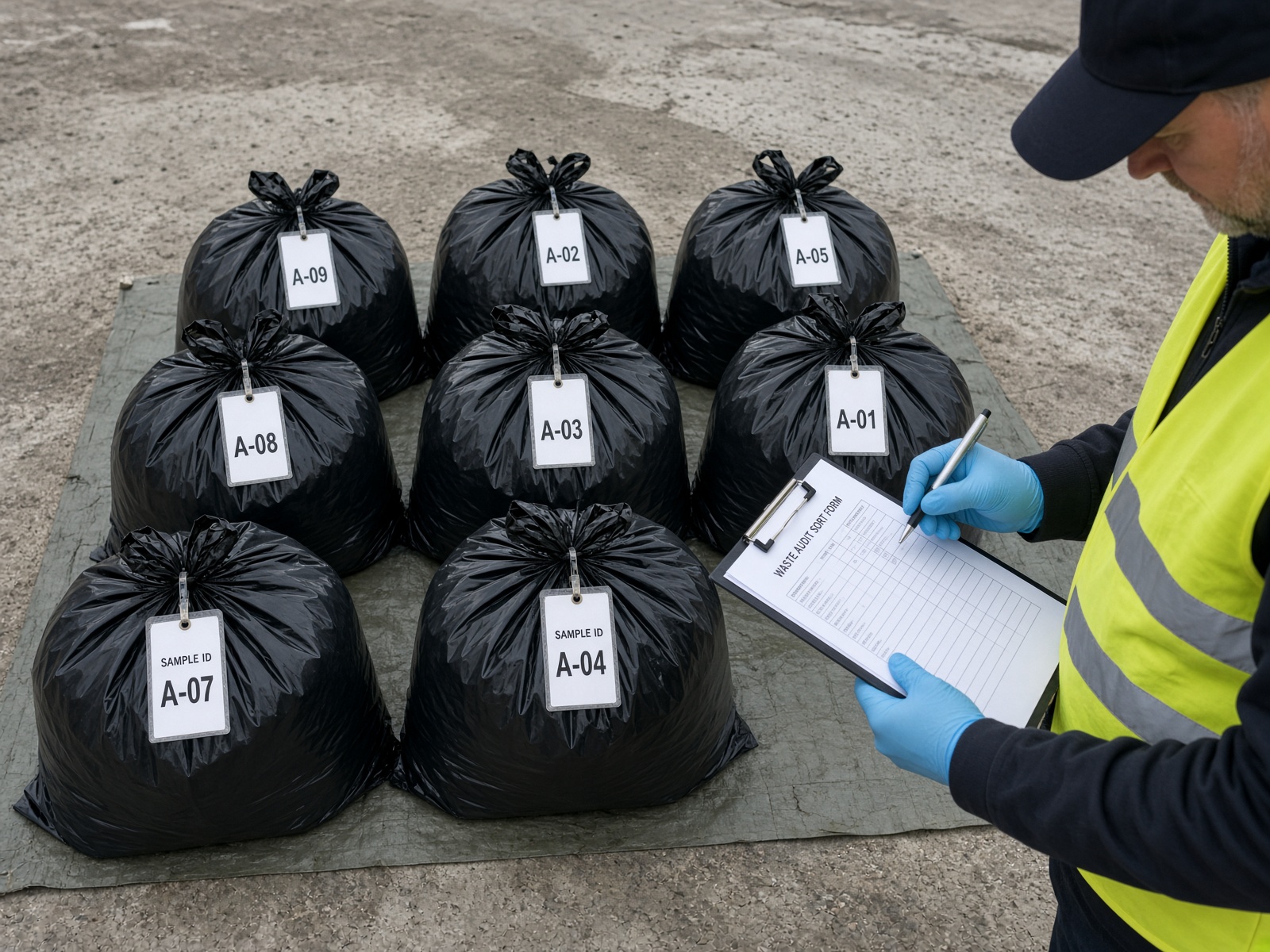
Source, stream, generation period, and sample ID are confirmed against the sample tracking log (F-02) before tipping; a sample that cannot be verified is quarantined on a separate tarp until traced — it enters the dataset verified or not at all. The tag stays with the material from this point forward.
Record gross weight
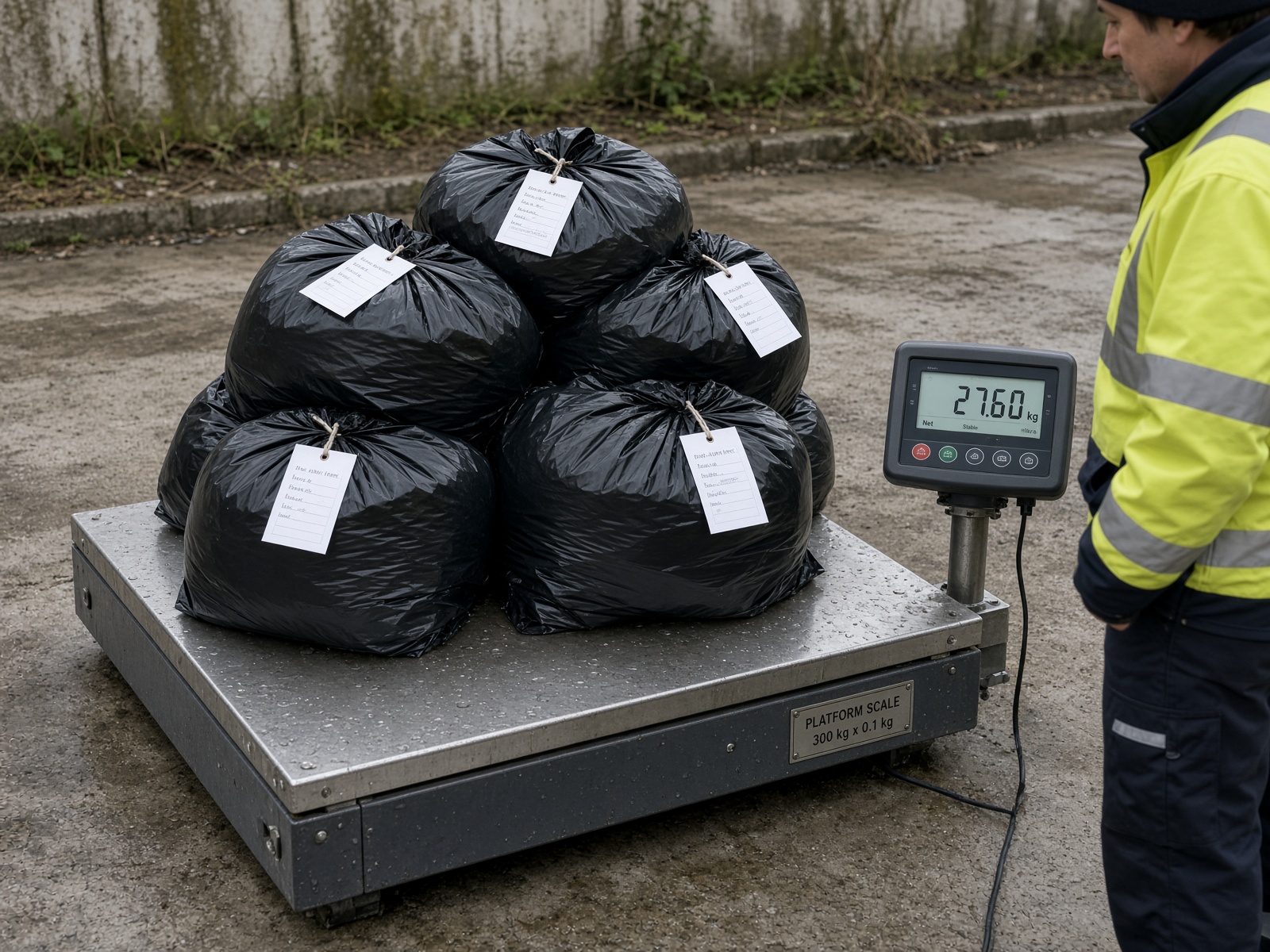
The full sample is weighed before any sorting — in its container or bags, tare-corrected — and entered on the tally sheet (F-03). This gross weight is the denominator of the mass-balance check and the anchor for the whole sample record. Oversized loads are reduced by coning and quartering (§03) after the full gross weight is recorded, with the retained fraction noted.
Tip & spread
The sample is tipped onto the tarp from knee height or lower — never dumped from standing height, which launches sharps and aerosolizes dust — and raked to roughly a single layer. The spread pile is photographed with its sample tag in frame (F-05); this photograph is the sample's visual record and frequently answers later questions no form anticipated.
Open every bag
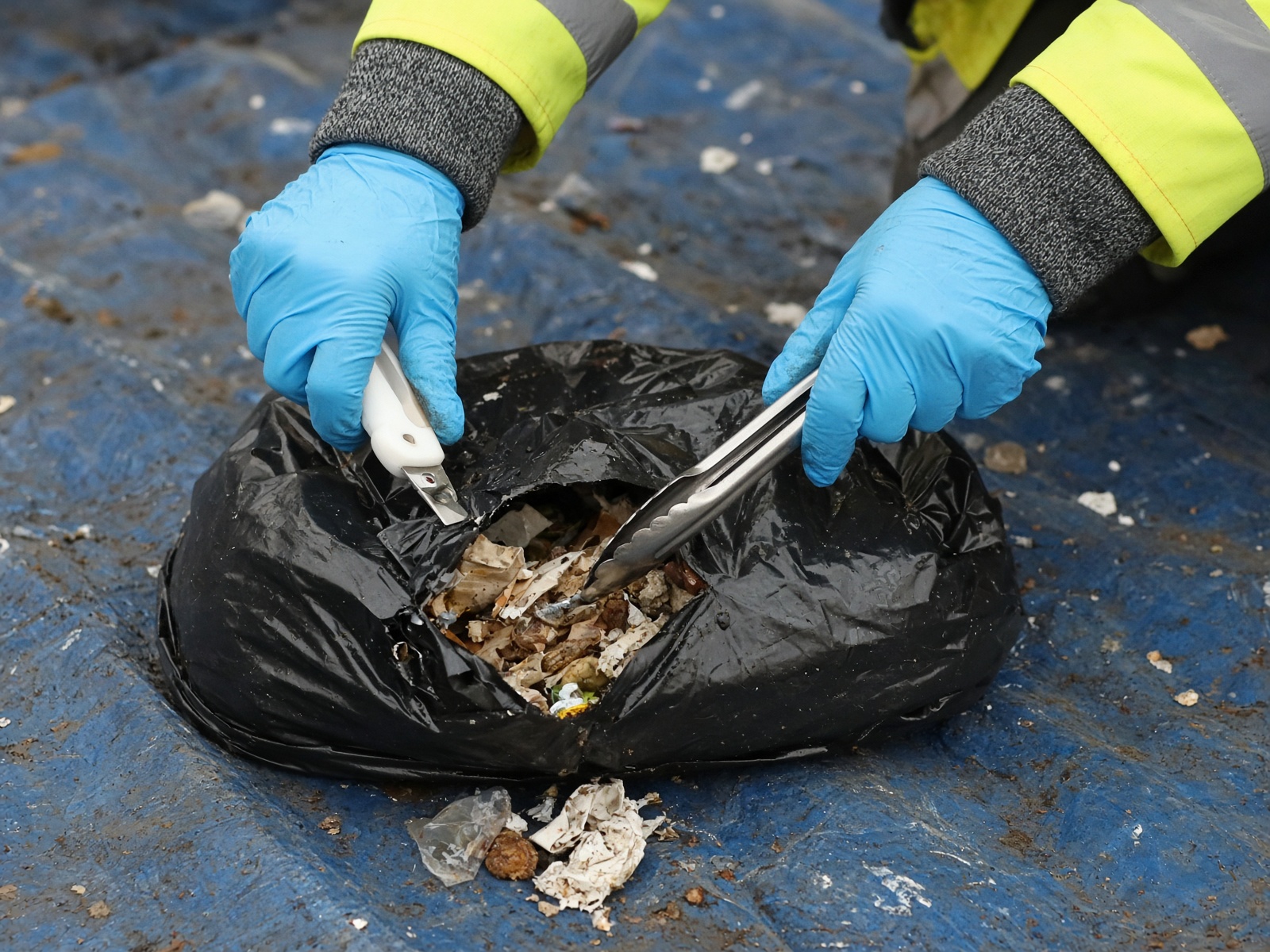
Bags frequently contain further bags. Each is cut open — cut rather than torn, blade moving away from the body, tongs first where contents are unknown — and its contents spread. No material is categorized while still bagged, and no bag is categorized by its apparent contents; the emptied bag itself goes to film plastics.
Sort to categories
Sorters work the edge of the pile toward the centre, two-handed, moving material to the labelled bins arranged per the §05 reach plan. Every item goes to a bin — no unclassified pile accumulates. The §06 decision rules govern composites, containers with contents, and soiled fibre; anything the rules do not cover goes to the supervisor, whose ruling is recorded on F-04 and applied for the remainder of the audit. Items on the §04 never-hand-sort list move by tongs to the set-aside container.
Weigh every category
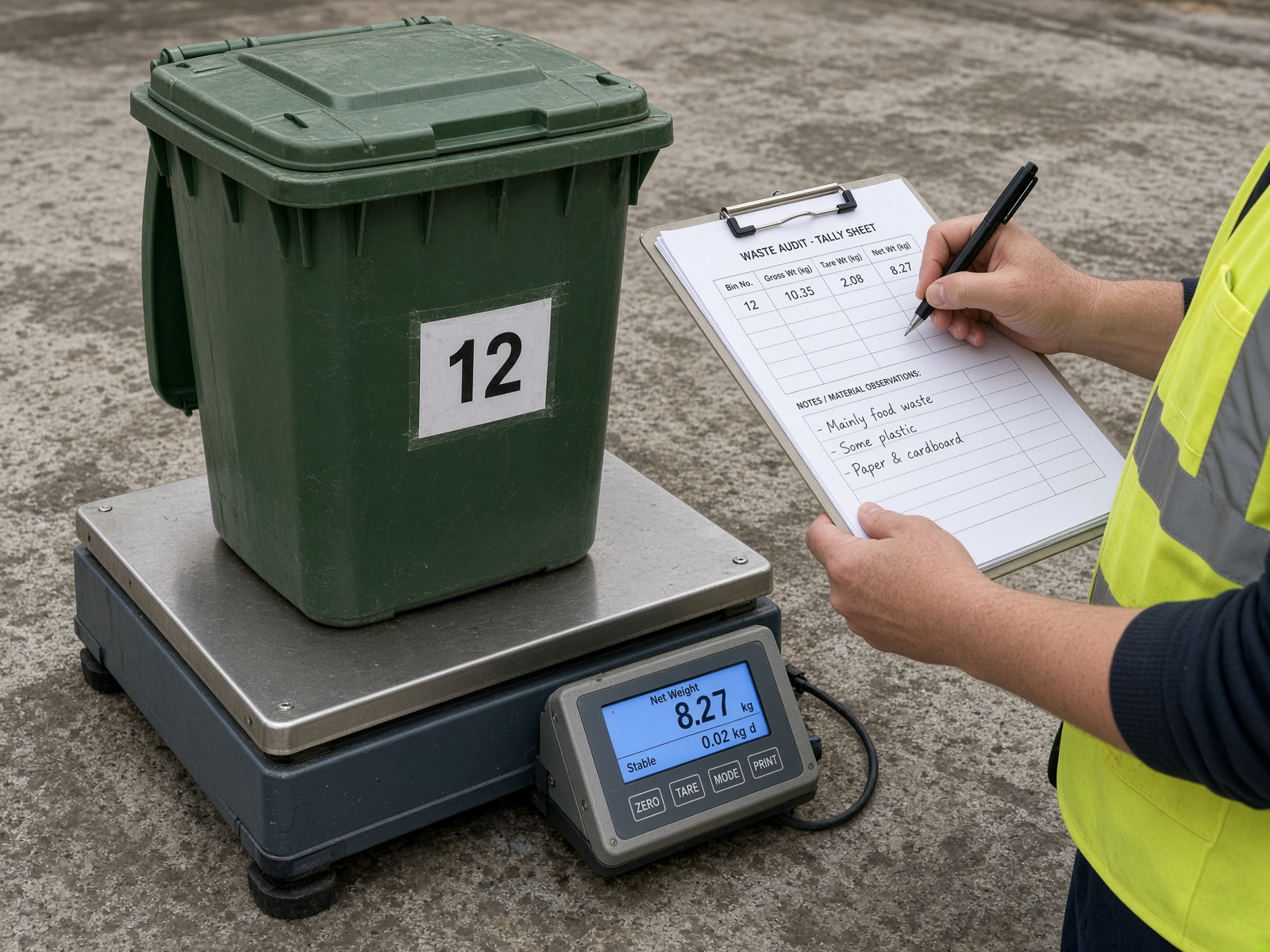
At the end of the sample — not before — each bin goes to the scale. Net weight = gross reading − that bin's logged tare, recorded to the scale's full resolution. All bins are weighed, including near-empty ones; zero values are recorded as data. Liquids encountered during the sort were decanted and noted (F-04); visibly saturated material is flagged so the analysis (§09) can treat its moisture bias.
Mass-balance check, then clear
The recorder sums the category nets and compares them to the gross weight before anything is disposed of. If the check passes, bins are emptied to the disposal route by stream, re-tared if their tare could have changed (wet residue), and the floor is cleared for the next sample. If it fails, the reconciliation steps below run while the sample is still on the floor — this is the reason disposal waits for the check.
| gross − Σ category nets | ÷ gross ≤ 5%
Keeping samples separate
Most data corruption on a sort floor is not mismeasurement but mixing. Three rules prevent it: one sample on the floor at a time — the next sample stages on its own tarp, tagged, outside the sort area, and nothing tips until the previous sample's mass balance has passed and its bins are empty; bins are emptied between samples, always — a bin that carries material across a sample boundary corrupts both samples, and re-taring after wet loads keeps the tare column honest; and the tag travels with the material — from arrival through the spread-pile photograph to the tally sheet header, the sample ID appears at every step, so no weight is ever orphaned. Where two samples must run in parallel (a large crew, two tables), they run in physically separated lanes with separate bin sets and separate recorders — parallel lanes, never shared bins.
Planning the day's throughput
Sort rate is the number that turns a sampling plan into a schedule, and it depends most strongly on category depth. As planning guidance — indicative figures, to be replaced by your own crew's measured rate after the first audit day:
| Category depth | Approx. throughput per sorter-hour | 91–136 kg sample, crew of 4 |
|---|---|---|
| Coarse (8–12 tier-2 categories) | ~60–100 kg | ~30–45 min |
| Standard (up to 23 tier-2) | ~40–70 kg | ~45–75 min |
| Fine (tier-3 open, 30+ categories) | ~20–40 kg | ~1.5–2.5 h |
Two implications follow. A four-to-five-person crew on a standard list processes roughly four to eight sorting samples in a field day — which is why the sample counts from §03 translate directly into crew-days and budget. And when the day runs behind, the correct response is to reduce tier-3 depth for remaining samples (recording the change on F-04) or hold verified samples covered overnight — never to rush the weighing or skip the mass balance.
Moisture and weather in the field
Moisture is the largest field-controllable bias in composition data: water migrating from food waste into paper inflates fibre weights and deflates organics. Field controls are simple — samples are sorted the same day they are collected wherever possible; staged samples are kept covered and off hot pavement; liquids are decanted when found, not left to soak; visibly saturated samples and rain during the sort are noted on F-04. The analytical treatment of what remains is addressed in §09.
Day-of logistics
Custodial coordination is confirmed the day prior: collection times, which containers hold the sample period's material, and a hold on compaction where the equipment allows it. Departmental samples arrive in labelled bags from the point of generation (§02) and are staged by department. Occupancy for the period — employees on site, patients, students, covers — is obtained from the host while on site; it is far harder to reconstruct later. Where the sort runs at the host facility, loading-dock scheduling and the host's traffic plan (§04) are agreed before the crew arrives.
Day-of logistics
Collection crews run ahead of the regular truck on the audited routes, collecting tagged set-outs into the audit vehicle; timing is coordinated with the hauler so no audited household is missed or double-collected. Set-outs are counted on route as collected (§02). Household linkage is maintained by anonymized sample ID — address lists stay with the route supervisor, never on the sort floor. Resident interactions follow a prepared script: identify the study, refer questions to the municipal contact, and never debate at the curb; a resident's refusal is honoured, counted, and replaced per the §02 selection procedure.
When the day departs from the plan
| Situation | Response |
|---|---|
| Sample arrives unlabelled or untraceable | Quarantine on a separate tarp; trace against F-02 and the collection record; if it cannot be verified, it is excluded and the exclusion documented |
| Rain begins mid-sort | Cover the active sample first, then equipment; resume under shelter or hold the sample covered; note timing on F-04 for the moisture record |
| Scale fails or drifts | Switch to the backup scale, re-verify with the check weight, and flag all weights since the last good verification for review (§05 procedure) |
| Crew short-handed | Reduce category depth (record the change), not the QA steps; a smaller, clean dataset outranks a larger compromised one (§03 tiers) |
| Load too large to sort | Record full gross weight, then cone and quarter to sorting-sample size (§03); reduction steps logged on F-02 |
| Hazardous or distressing find | §04 protocols govern: set-aside by tongs, supervisor manages, crew may step away without explanation |
| Day running long | Hold verified, covered samples overnight in the §05 secure hold; never rush weighing or skip the mass balance to finish |
Closing the day
The QA block at day's end is short and non-negotiable: every F-03 column footed and every sample's mass balance confirmed; every F-04 ruling and observation legible and attributed; the photo log (F-05) reconciled against the camera; and every completed form photographed on the spot — the cheapest data backup that exists, done before the paper rides home in a vehicle. The supervisor leads a five-minute debrief (what happened, what nearly happened, what changes tomorrow), the crew signs out, and teardown proceeds per the §05 decontamination procedure. Data entry from the photographed forms follows in §08.
Sources & further reading
- ASTM International — D5231-92(2016) (sorting procedure, sample handling, and mass-reconciliation practice)
- Ontario Ministry of the Environment — A Guide to Waste Audits and Waste Reduction Work Plans (field procedure guidance)