Waste Categories
Every audit sorts into a fixed category list agreed before sort day. This site uses a three-tier hierarchy — primary stream, material category, detailed sub-category — designed to be trimmed to the audit's objective. Categories are never invented mid-sort; consistency of definition is what makes results comparable across sites, seasons, and years.
The three-tier hierarchy
Tier 1 identifies where material could go (its stream); tier 2 identifies what it is (its material); tier 3 subdivides where the objective demands finer resolution. Sorting to tier 2 is the working default (§02); each tier-3 subdivision roughly doubles sorting time for the affected material and is opened only with a reason.
The reference category list
The list below is the site's master reference; the downloadable version carries category codes and definitions suitable for the tally sheet. "Recyclable" and "compostable" describe common program pathways, not guarantees — the list is reconciled against the local program's accepted materials during design (§02).
| Tier 2 category | Tier 3 subdivisions (open as needed) | Sorting notes |
|---|---|---|
| Corrugated cardboard (OCC) | Clean · waxed · soiled | Flatten to judge; waxed OCC is not fibre-recyclable in most programs |
| Boxboard | — | Cereal, tissue, shoe boxes; liners removed to their own material |
| Mixed paper | Newsprint · office paper · magazines/flyers · shredded | Personal documents bagged unread (§02 privacy protocol) |
| Aluminum containers | Beverage cans · foil & trays | Foil heavily soiled with food may be ruled to residual — record the ruling |
| Steel/tin cans | — | Magnet wand distinguishes from aluminum where unclear |
| Glass containers | Clear · coloured | Broken glass handled with tongs; non-container glass (ceramics, window) → residual |
| PET bottles (#1) | Deposit · non-deposit | Deposit split matters where deposit-return programs operate |
| HDPE containers (#2) | — | Jugs and rigid bottles; caps stay with the container |
| Other rigid plastics | #3–#7 · tubs & lids · polystyrene | Polystyrene opened as its own tier 3 where a local program exists |
| Film & flexible plastics | Shopping bags · stretch wrap · other film | Empty of contents before weighing; a large hidden bias otherwise |
| Cartons & poly-coated fibre | Gable-top · aseptic · paper cups · laminated/poly-coat | Emptied and drained before weighing |
| Food waste | Avoidable (edible, by food type) · unavoidable (peels, bones) | The avoidable/unavoidable split is the key tier 3 for prevention studies; avoidable subdivides by food type where required |
| Yard & garden waste | Grass/leaves · brush & branches | Highly seasonal — the main argument for multi-season design (§02) |
| Compostable paper & certified compostables | Food-soiled paper · certified compostable packaging | Towels, napkins, certified compostable plastics; only where the local program accepts them |
| Textiles, rubber & leather | Reusable clothing · other | Reusable split supports reuse-program design |
| Composite & multi-material | — | Chip bags, laminates, blister packs — inseparable by hand; see decision rules |
| Hygiene products | Diapers · sanitary · pet waste | Weighed, never opened or examined |
| Wood & C&D | Clean wood · treated/finished · rubble | Treated wood is not compostable or burnable — keep the tier 3 split |
| Other residual | Fines (<25 mm) · bulky items · miscellaneous | Fines screened where a screen is available; bulky items weighed individually and noted |
| Electronics | — | Weighed intact; batteries left inside are noted on F-04 |
| Batteries | Single-use · rechargeable/Li-ion | Damaged lithium cells follow the §04 set-aside procedure |
| Household hazardous | Paints/solvents · pesticides · other | Containers never opened; weighed container-and-all, method noted |
| Sharps & biomedical | — | Never hand-sorted (§04); recorded and weight-estimated from a safe position |
Alignment with the 73-material coefficient list
Audits that will feed an emissions or diversion model need finer material resolution than a sort table can practically handle. The guide resolves this with two aligned layers: the 23 tier-2 categories above remain the sorting layer, and the 73-material list used by the companion emissions-coefficient workbook forms the analytical layer. Every workbook material maps to exactly one tier-2 home, so data sorted at tier 2 rolls up to the workbook's six groups directly, and an audit that needs workbook-level resolution simply opens the relevant tier-3 splits on sort day. The crosswalk below is the complete mapping; the downloadable category list and tally sheet carry the same codes.
Three deliberate divergences are worth noting, because the rollup direction matters when exporting: the workbook groups personal care/sanitary products, pet waste, and small wood waste under Organics, whereas the guide sorts the first two under Hygiene products (residual) and the third under Wood & C&D — the crosswalk, not the sort-floor category, governs which workbook group they report to. Steel aerosol and paint cans map to metals only when verifiably empty; otherwise they follow the §04 hazardous-materials handling. And the workbook's "Total household special waste" row is an aggregate, not a sorted category.
Full crosswalk · 73 workbook materials → guide categories
| Workbook material | Guide tier-2 home | Note |
|---|---|---|
| Paper · 15 materials | ||
| Newsprint (flyers, newspapers, etc.) | Mixed paper | |
| Kraft | Mixed paper | kraft bags & paper |
| Magazines & catalogues | Mixed paper | |
| Mixed paper | Mixed paper | |
| Other mixed paper | Mixed paper | |
| Books — non-reusable | Mixed paper | |
| Books — reusable | Mixed paper | reusable flag noted for reuse programs |
| Corrugated wine bag-in-box | Corrugated cardboard (OCC) | bladder removed to film plastics |
| Other corrugated | Corrugated cardboard (OCC) | |
| Boxboard / cores & moulded pulp | Boxboard | |
| Paper cups — hot & cold beverage | Cartons & poly-coated fibre | |
| Laminated paper packaging | Cartons & poly-coated fibre | |
| Poly coat (cartons, composite cans) | Cartons & poly-coated fibre | |
| Aseptic — other containers | Cartons & poly-coated fibre | |
| Aseptic — alcohol | Cartons & poly-coated fibre | deposit-return split |
| Plastics · 10 materials | ||
| LDPE bags and film | Film & flexible plastics | |
| Alcohol bottles (plastic) | PET bottles (#1) | deposit-return split |
| #1 PET bottles & jars | PET bottles (#1) | |
| #2 HDPE bottles, jars, jugs & tubs | HDPE containers (#2) | |
| Other plastic jars, jugs, etc. (#3, #4, #5, #7) | Other rigid plastics | |
| #6 polystyrene packaging — rigid | Other rigid plastics | tier-3 polystyrene |
| #6 polystyrene packaging — foam | Other rigid plastics | tier-3 polystyrene foam |
| Plastic medical waste | Sharps & biomedical | hazard rule governs handling (§04) |
| BLACK plastic — all types | Other rigid plastics | optical-sorting-driven category |
| Other plastic packaging | Other rigid plastics | |
| Glass · 4 materials | ||
| Clear alcoholic beverage glass | Glass containers | clear · deposit-return split |
| Green/brown alcoholic beverage glass | Glass containers | coloured · deposit-return split |
| Clear glass — other & food | Glass containers | clear |
| Green/brown glass — other & food | Glass containers | coloured |
| Metals · 7 materials | ||
| Aluminum alcoholic beverage cans | Aluminum containers | deposit-return split |
| Aluminum foil & foil trays | Aluminum containers | tier-3 foil |
| Other aluminum containers | Aluminum containers | |
| Steel alcoholic beverage cans | Steel / tin cans | deposit-return split |
| Steel food & beverage cans | Steel / tin cans | |
| Steel aerosol cans | Steel / tin cans | only when verifiably empty; otherwise Household hazardous (§04) |
| Steel paint cans | Household hazardous | empty, dry cans may be ruled to Steel — record the ruling |
| Organics · 12 materials | ||
| Yard waste | Yard & garden waste | |
| Grass clippings | Yard & garden waste | tier-3 grass/leaves |
| Small wood waste | Wood & C&D | workbook groups under Organics — rolls up there on export |
| Pet waste | Hygiene products | workbook groups under Organics — see divergence note |
| Personal care & sanitary products | Hygiene products | workbook groups under Organics — see divergence note |
| Certified compostable plastic | Compostable paper & certified compostables | |
| Other compostable paper | Compostable paper & certified compostables | |
| Leftover & untouched — bakery | Food waste | avoidable, tier-3 by food type |
| Leftover & untouched — meat & fish | Food waste | avoidable, tier-3 by food type |
| Leftover & untouched — dairy & food | Food waste | avoidable, tier-3 by food type |
| Leftover & untouched — fruits & vegetables | Food waste | avoidable, tier-3 by food type |
| Leftover & untouched — other | Food waste | avoidable |
| Other Materials · 25 materials | ||
| Carpets and mattresses | Other residual | tier-3 bulky items |
| Small appliances | Electronics | |
| Textiles — reusable | Textiles, rubber & leather | reusable split |
| Textiles — scrap | Textiles, rubber & leather | |
| Tires (other, not rubber) | Other residual | workbook definition governs |
| Tires & rubber | Textiles, rubber & leather | tires often route to a stewardship program |
| Construction & renovation waste | Wood & C&D | |
| Ceramics (non-reusable) | Other residual | |
| Diapers | Hygiene products | |
| Coffee pods | Composite & multi-material | |
| Other waste (unclassified) | Other residual | |
| Furniture of all types (wood, plastic, metal) | Other residual | tier-3 bulky items |
| Furniture | Other residual | near-duplicate of the row above in the workbook — confirm intended distinction |
| Other large bulky items | Other residual | tier-3 bulky items |
| Batteries — single-use | Batteries | |
| Batteries — rechargeable | Batteries | tier-3 Li-ion handling per §04 |
| Fluorescent tubes & CFLs | Household hazardous | mercury-containing — never broken intentionally |
| Engine oil, containers & filters | Household hazardous | |
| Pharmaceuticals & sharps, syringes | Sharps & biomedical | never hand-sorted (§04) |
| Other HSW liquids & items | Household hazardous | |
| Total household special waste | — | aggregate/rollup row in the workbook, not a sorted category |
| Computer monitors & components | Electronics | |
| Computer peripheral devices | Electronics | |
| Audio/video equipment | Electronics | |
| Phones, IT equipment & other electronics | Electronics | |
Photo glossary
The sorters' visual reference: one representative image per tier-2 category, printable as table cards. The images below are openly licensed photographs from Wikimedia Commons, each linked to its source page; they serve as working placeholders until the glossary is reshot in a consistent style (top-down, neutral surface) during a real audit. Licences should be verified against each source page before public launch, and required attributions carried in the site credits.


Images: Wikimedia Commons, hotlinked under each file's stated licence via the linked source pages. Hygiene products and sharps are deliberately represented without photographs. Note: images display in the site itself; the claude.ai preview page suppresses external images by policy, showing labelled tiles instead.
Decision rules for the sort table
Edge cases are resolved by standing rules, applied identically by every crew member, so that two crews sorting the same waste produce the same numbers. The supervisor rules on anything the list below does not cover, and every ruling is recorded on the observations log (F-04) so it can be applied consistently for the rest of the audit — and in the next one.
- Dominant material. A composite item that cannot be separated by hand in a few seconds is assigned to the dominant material by weight; if no material dominates, it goes to Composite & multi-material.
- Separable in seconds. If components separate by hand quickly (lid from jar, liner from box), they are separated and sorted to their own categories; longer disassembly is not attempted.
- Containers with contents. Food containers are emptied — contents to Food waste, container to its material. Liquids are decanted before weighing and noted; sealed unidentifiable containers follow the §04 set-aside rule.
- Bagged material. Every bag is opened and its contents sorted; the bag itself goes to Film plastics. No bag is categorized by its apparent contents.
- Soiling. Light soiling does not change a category (a greasy pizza box is still fibre — programs differ on acceptance, which the analysis handles); saturation does (paper soaked in liquid food may be ruled compostable paper or residual per the local program, recorded once and applied throughout).
- Hazard trumps material. Any item on the §04 never-hand-sort list goes to its Special category regardless of what it is made of.
- Privacy trumps curiosity. Personal documents, mail, and prescriptions are bagged unread into Mixed paper; nothing legible is photographed (§02).
- Size floor. Fragments below ~25 mm are not chased individually; they are collected as Fines at cleanup and weighed as a category.
Adapting the list
The reference list is a starting point, adapted in three directions during design (§02). It is trimmed for constrained audits — a screening sort might collapse to eight tier-2 categories without losing its purpose. It is aligned to the local program, so "recyclable" reflects what the program actually accepts; capture and contamination rates are meaningless against a generic list. And it is occasionally extended where an objective demands a category this list lacks — a campus audit tracking coffee cups as their own tier 3, a manufacturer tracking a specific input material. Whatever the adaptation, tier-2 names are kept stable between audit rounds: renaming a category breaks the year-over-year comparison that §11 depends on.
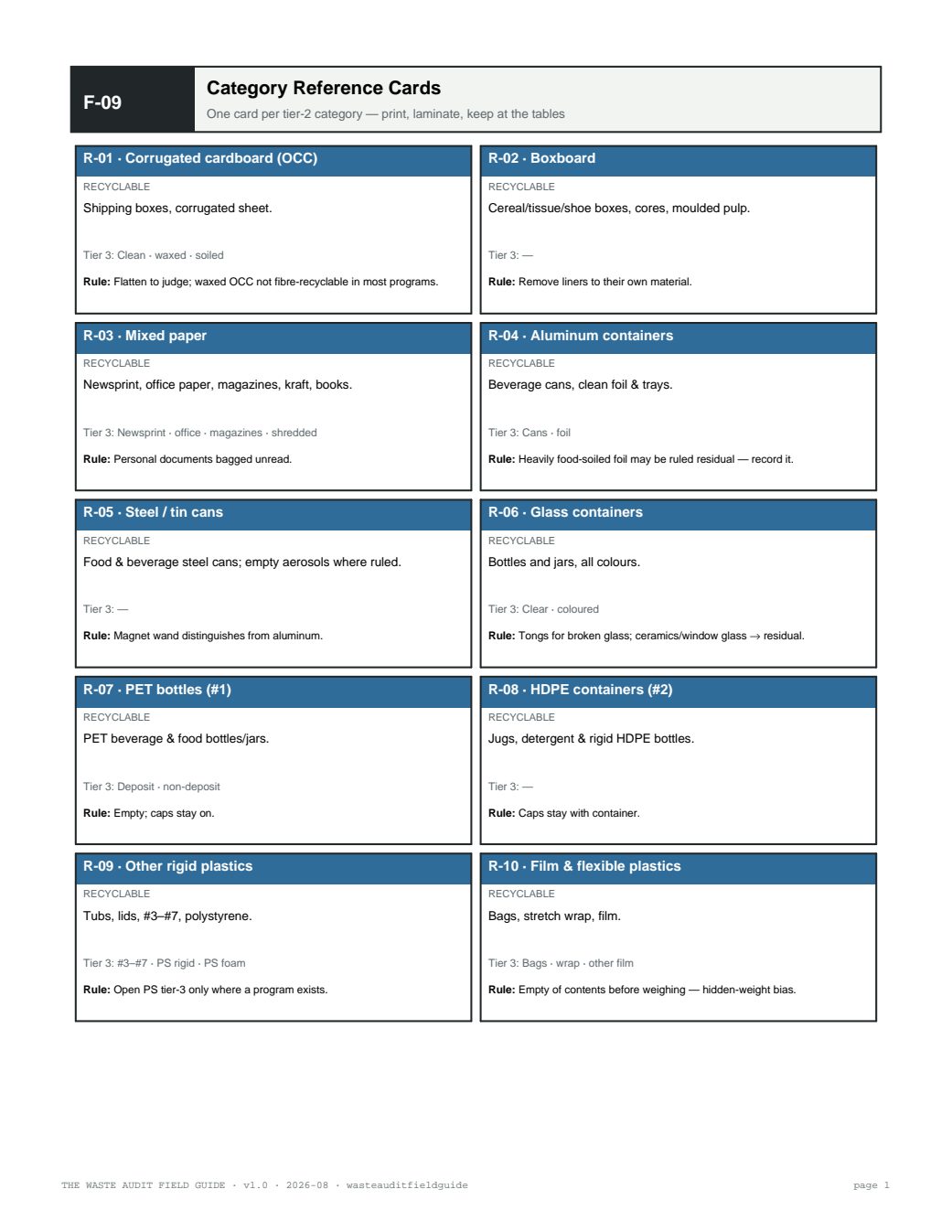
F-09 · Category Reference Cards
The glossary as printable table cards: photo, definition, tier-3 splits, and the decision rules that touch the category. Laminated sets survive the sort floor.
PDF — click the sheet or the buttonRelated
Container labels use these category names verbatim (§05). The category list version number is recorded on the design brief (F-00) and the tally sheet (F-03), so every dataset is traceable to the exact list it was sorted against.
Sources & further reading
- Glossary photographs — Wikimedia Commons, individual source pages linked per image; licences to be verified and attributed in the site credits before public launch
- Category structures adapted from common practice in municipal composition studies (e.g., Metro Vancouver 2024) and ICI audit guidance (Ontario MOE guide)